

Lab-Grown vs Natural Diamond Engagement Rings: An Honest UK Guide for 2026
It's the question we hear more than any other in our Hatton Garden showroom, usually within the first five minutes. Should we go lab-grown or natural?
The short answer
Lab-grown and natural diamonds look the same and are the same material, but they behave very differently as purchases. Neither is the right choice for everyone. It depends on what matters most to the two of you.
Choose lab-grown for
- A bigger, brighter stone for your budget
- Typically 60–80% less than a comparable mined diamond
- An easy-to-trace origin
Choose natural for
- Rarity, formed over billions of years
- Holding more of its value
- An heirloom to pass down
We sell both at Chloe's Jewellers, so we've no reason to push you one way. What follows is the same conversation we'd have with you across the counter on Greville Street, with real prices from our own cases.
What is a lab-grown diamond, exactly?
A lab-grown diamond is a real diamond. Not a lookalike, not a coating, not cubic zirconia. It's crystallised carbon with the same structure, hardness and sparkle as a mined stone.
The only difference is where it grew. Natural diamonds formed deep underground under enormous heat and pressure. Lab-grown diamonds are made by recreating those conditions in a controlled setting, using one of two methods:
- HPHT (high pressure, high temperature): copies the crushing heat and pressure deep in the earth.
- CVD (chemical vapour deposition): builds the diamond up layer by layer from carbon-rich gas.
Both produce stones that score 10 on the hardness scale, the same as any natural diamond. That matters for an engagement ring, because it's worn every day and knocks against everything.
Worth knowing
Moissanite and cubic zirconia are not lab-grown diamonds. They're different materials that imitate the look. If a price seems too good to be true, ask what the stone actually is.
Can anyone tell the difference?
With the naked eye, no. Not your friends, not your family, and honestly not most jewellers either without the right kit.
A standard handheld diamond tester will read a lab-grown stone as a diamond, because it is one. Telling the two apart takes specialist equipment that picks up tiny differences in how the crystal grew. That's why grading laboratories exist.
So the paperwork matters more than the look. A reputable grading report states clearly whether a stone is natural or laboratory-grown, and lab-grown stones are often laser-inscribed on the girdle to say so. Many of our natural diamond engagement rings come with GIA certificates, and whichever you choose, you should always be given the grading report with your ring.
Lab-grown vs natural diamond price in the UK
This is where the difference really shows. Across the UK market, lab-grown diamonds typically cost 60–80% less than a comparable mined stone. Rather than quote averages, here are three rings from our own collection:
 Lab-grown1.09ct round, double halo£1,850View ring
 Natural0.43ct round, split shank£2,000View ring
 Natural1.20ct round, diamond shoulders£6,500View ring
What your money buys
Prices from our collection at the time of writing. Settings differ slightly, so treat this as a guide.
Compare the first two rings. For a little less money, the lab-grown ring gives you a centre stone more than twice the size. Now compare the two stones over a carat: the natural diamond costs roughly three and a half times as much.
That's the honest appeal of lab-grown: you can have the bigger stone, or the better colour and clarity, without stretching your budget.
Do lab-grown diamonds hold their value?
This is the part a lot of sellers skip, so we'll be straight with you: no, not really.
Lab-grown diamonds can be made in any quantity, and their prices have fallen sharply over the past few years. Because of that, there's very little demand for them second-hand.
Typical resale value, as a share of what you paid
Estimates vary widely between sources and depend on the stone, the paperwork and who's buying.
Natural diamonds don't make you money either, whatever anyone tells you. You'll rarely sell one for what you paid in a shop. But because the supply is finite, they keep a meaningfully larger share of their value.
It's the reason we run our Sell Your Jewellery service: natural diamonds and designer pieces from houses like Cartier and Van Cleef & Arpels have a genuine second-hand market.
The way we see it: if you never plan to sell the ring, resale value hardly matters. If the idea of passing down something that keeps its worth is important to you, it matters a lot.
Ethics and sustainability: it's not as simple as it sounds
Lab-grown diamonds are often sold as the ethical choice, full stop. The reality is more nuanced, and you deserve both sides.
The case for lab-grown: there's no mining involved, so no land is dug up, and the origin of every stone is easy to trace. For couples worried about where their diamond came from, that's real peace of mind.
The other side: growing diamonds takes a lot of electricity. How green a lab-grown stone is depends heavily on how that power was generated, which isn't always disclosed.
The case for natural: responsibly sourced natural diamonds come through the Kimberley Process, which exists to keep conflict diamonds out of the supply chain. Diamond mining also supports jobs and economies in producing countries such as Botswana.
Our advice is to ask any jeweller, including us, exactly where a stone came from. You can read how we approach this on our Ethical Sourcing page.
What are UK couples actually choosing in 2026?
Lab-grown has moved from niche to mainstream remarkably fast. One Hatton Garden bespoke jeweller, Queensmith, reports that 79% of the engagement rings it made in 2026 used a lab-grown diamond. Other UK retailers report figures above 60%.
Those numbers come from jewellers who specialise in lab-grown, so they don't tell the whole story. Natural diamonds remain the first choice for many couples, especially for heirloom pieces and larger, rarer stones.
A third option
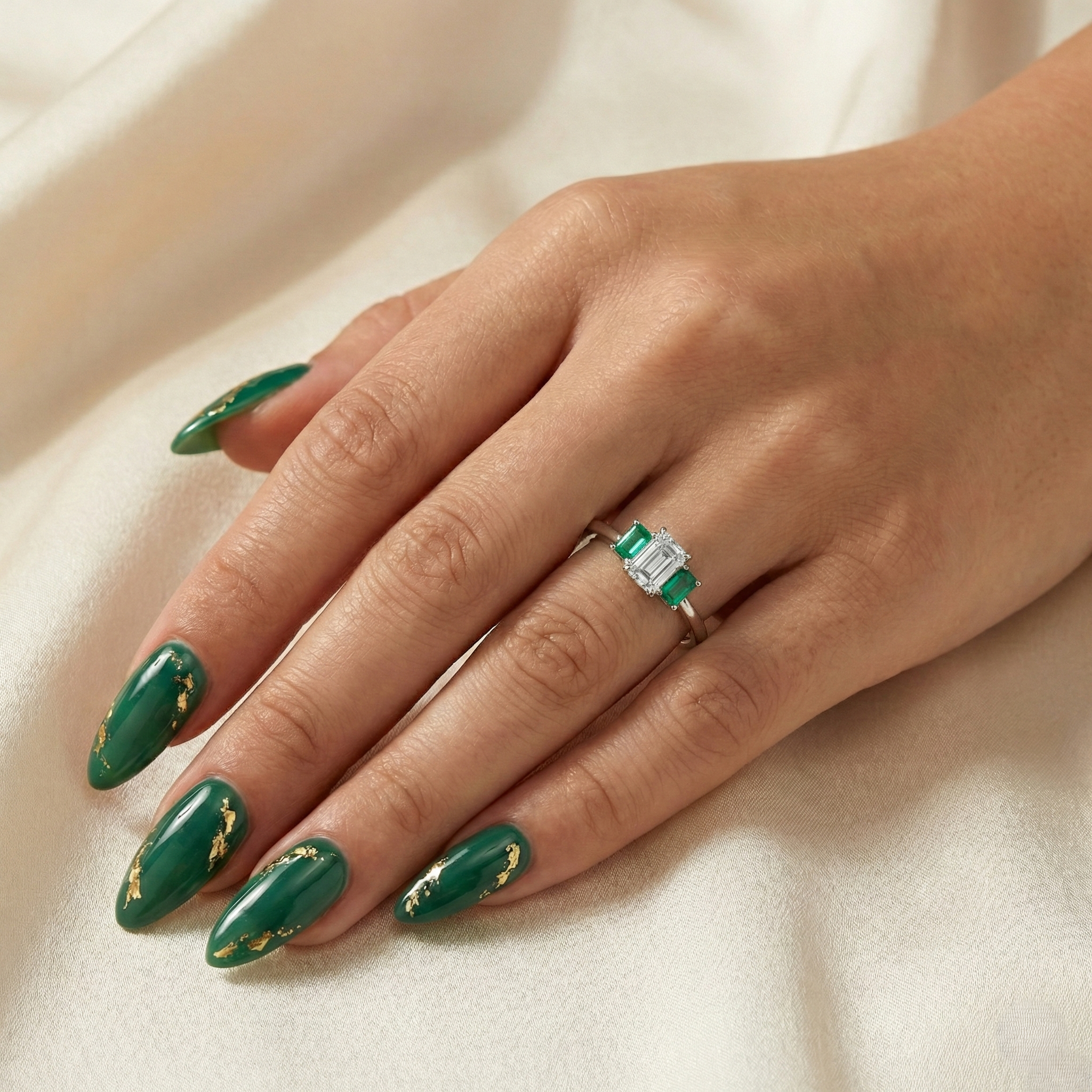
Plenty of couples skip the diamond debate altogether and choose a coloured gemstone. A sapphire, emerald or ruby gives you a natural, characterful stone, often with far more size for the money than a natural diamond. Read our coloured gemstone guide, or browse our blue sapphire and emerald engagement rings.
So which should you choose?
Forget what's trending for a moment. Here's how we'd help you decide.
Lab-grown is probably right if
- You want the biggest, brightest stone your budget allows
- You'd rather put money towards the wedding, a honeymoon or a house deposit
- You're confident you'll never want to sell the ring
- Traceability matters more to you than rarity
Natural is probably right if
- A stone that's billions of years old means something to you
- You'd like the ring to become an heirloom that holds its worth
- You prefer a smaller, rare stone to a larger, plentiful one
- You may want to upgrade or trade the stone in years to come
Still torn? It's worth seeing both side by side. Under shop lighting, most couples know within a few minutes which one feels right.
Frequently asked questions
Are lab-grown diamonds real diamonds?
Yes. They have the same chemical make-up, crystal structure and hardness as natural diamonds. They're not imitations like cubic zirconia or moissanite.
Will a lab-grown diamond go cloudy or lose its sparkle?
No. Like any diamond, it stays as bright as the day you bought it. A ring can look dull when it's dirty, so give it a gentle clean now and then. Our jewellery care guide explains how.
Can I insure a lab-grown diamond ring?
Yes, just like a natural one. Keep your receipt and grading report safe, as your insurer will want to see both.
Will lab-grown diamond prices keep falling?
Prices have dropped a lot in recent years, and nobody can say for sure where they'll settle. That's another reason to buy lab-grown because you love it, not as a store of value.
Are natural diamonds a good investment?
Not in the stock-market sense. They hold value far better than lab-grown stones, but a ring bought from a shop is rarely resold for a profit.
Is it cheaper to buy an engagement ring in Hatton Garden?
Often, yes. Independent Hatton Garden jewellers avoid the big overheads of high street chains and luxury brands, which usually shows in the price. We also offer a price match guarantee and payment plans.
How do I choose the shape and setting?
That's a whole conversation of its own. Our Ultimate Guide to Choosing the Perfect Engagement Ring walks you through it.
See both side by side in Hatton Garden
Hold a lab-grown and a natural diamond next to each other and see which one you keep coming back to. Greville House, 35 Greville Street, Monday to Saturday, 10:30am to 5:30pm.
Book an appointmentBrowse engagement ringsFree UK delivery, a 21-day returns policy and membership of the National Association of Jewellers come with every order.