

Sapphire, Emerald or Ruby? The Complete Guide to Coloured Gemstone Engagement Rings
For most of the last century, engagement ring meant a white diamond. That's changing fast. Coloured stones are one of 2026's biggest engagement ring trends, and plenty of couples have realised that a deep blue sapphire or a vivid green emerald says something a diamond can't.
It isn't new, of course. Sapphires, rubies and emeralds have been set in engagement rings for centuries. In Britain the most famous example is the oval sapphire ring given to Lady Diana Spencer in 1981, now worn by the Princess of Wales.
The short answer
Sapphire is the best all-rounder, ruby is just as tough with a more passionate colour, and emerald is the most romantic but needs more care.
Which gemstones can handle everyday wear?
An engagement ring is worn every day and knocked against desks, door handles and car keys. So before falling for a colour, it's worth knowing how tough each stone is. Hardness is measured on the Mohs scale, from 1 to 10. It tells you how well a stone resists scratching.
How scratch-resistant each stone is (Mohs scale)
Sapphire and ruby are excellent for everyday wear. Emerald needs care and a protective setting.
Hardness isn't the whole story, though. Emeralds are reasonably hard, but they almost always contain natural inclusions that make them more prone to chipping from a sharp knock. That's why the setting matters as much as the stone.
Sapphire: the best all-rounder
If you want colour without worry, choose sapphire. At 9 on the Mohs scale, it's second only to diamond, so it copes happily with daily life. It's also far more varied than most people realise: sapphire covers every colour of the mineral corundum except red, which is ruby.
Blue sapphire is the classic. Look for a rich, even blue that isn't so dark it looks black indoors. Teal sapphires are having a real moment: they sit between blue and green and can shift between the two in different light, often at better value than a top blue of the same size. Pink and yellow sapphires are soft and romantic, or sunny and bright, with the same toughness.
 Blue sapphire0.95ct oval, halo£1,400View ring
 Blue sapphire1.10ct cushion, double halo£2,400View ring
 Blue sapphire1.20ct round, halo£3,700View ring
 Teal sapphire1.11ct pear£2,000View ring
 Teal sapphire2.52ct oval£3,200View ring
 Pink sapphire0.66ct round, halo£1,000View ring
See all our blue sapphire and yellow sapphire engagement rings.
Ruby: passion with real strength
Ruby is sapphire's red sibling, the same mineral in a different colour, so it's just as tough at 9 on the Mohs scale. It has stood for love and passion for centuries, which makes it a natural fit for an engagement ring.
| Origin | What it's known for |
|---|---|
| Burma (Myanmar) | The historic benchmark, prized for a vivid, glowing red |
| Africa | Now a major source of fine stones, often with excellent colour and clarity |
| Thailand | A deeper, darker red, and often very good value |
The colour to look for is a strong, pure red. Stones that lean slightly pink or purple can still be beautiful, but the most valuable rubies are a saturated red.
 Thai ruby0.90ct trilogy with diamonds£1,650View ring
 Burmese ruby1.08ct oval£2,400View ring
 Burmese ruby1.01ct with F VS1 diamonds£3,600View ring
See all our ruby engagement rings.
Emerald: the most romantic choice
Nothing quite matches the green of a fine emerald. It has a vintage, almost Art Deco glamour, and it looks wonderful in yellow gold.
The honest trade-off is care. Emeralds almost always contain natural inclusions, which the trade affectionately calls the stone's jardin, or garden. They're part of an emerald's character, but they also make it more vulnerable to a hard knock. Most emeralds are also treated with oil or resin to improve clarity, which is normal and accepted, and another reason to treat them gently.
Colombian or Zambian? Colombian emeralds are the most famous, admired for a warm, vivid green. Zambian emeralds tend towards a slightly cooler, bluish green and are often very clean. Both can be outstanding.
 Colombian emerald0.40ct square emerald cut£1,250View ring
 Zambian emerald0.60ct oval£1,700View ring
 Colombian emerald1.68ct halo, yellow gold£2,200View ring
 Colombian emerald0.93ct halo, platinum£4,150View ring
Looking after an emerald
Choose a protective setting such as a halo or bezel. Take it off for the gym, gardening and cleaning. Clean it gently with lukewarm, soapy water and a soft brush, and never use an ultrasonic or steam cleaner, as heat and vibration can damage the stone and its treatment.
See all our emerald engagement rings.
Beyond the big three
A few other stones make beautiful and distinctive engagement rings. Aquamarine is a calm, watery blue and good value for its size, though a little softer than sapphire. Alexandrite is the magic trick of the gem world, typically greenish in daylight and reddish-purple under warm indoor light. Topaz gives bright, affordable colour. And a natural fancy-coloured diamond combines diamond's hardness with real colour.
 Blue topaz1.70ct oval, platinum£1,350View ring
 Aquamarine0.84ct with diamonds£2,000View ring
 Fancy coloured diamond0.70ct GIA, double halo£8,500View ring
 Alexandrite7.01ct round, platinum£20,800View ring
How to judge a coloured gemstone's quality
Diamonds have the 4Cs. Coloured stones are judged a little differently, and colour matters most.
- Colour. Look for a rich, even colour that's neither too pale nor so dark it looks black away from bright light. View it in daylight and indoor light, as some shift noticeably.
- Clarity. Sapphires and rubies should look clean to the naked eye. Emeralds are expected to have some inclusions, so judge them on overall beauty, not perfection.
- Cut. A well-cut stone looks lively across its whole face. Watch for a window, a pale, washed-out patch in the middle where light leaks straight through.
- Origin. Some origins, such as Burmese ruby or Colombian emerald, carry a premium. A beautiful stone from a less famous source can be excellent value.
- Treatment. Heating sapphires and rubies to improve colour is standard and permanent, and oiling emeralds is standard too. Untreated stones are rarer and cost more. A good jeweller will always tell you how a stone has been treated.
- Certification. For a significant stone, an independent gemmological report confirms what it is, where it may come from and how it's been treated. Ask us which of our stones come with one.
Choosing the setting and metal
Settings
- Halo: adds sparkle, makes the gem look larger and helps shield its edges. Great for emeralds.
- Bezel: a smooth metal rim, the most protective setting of all.
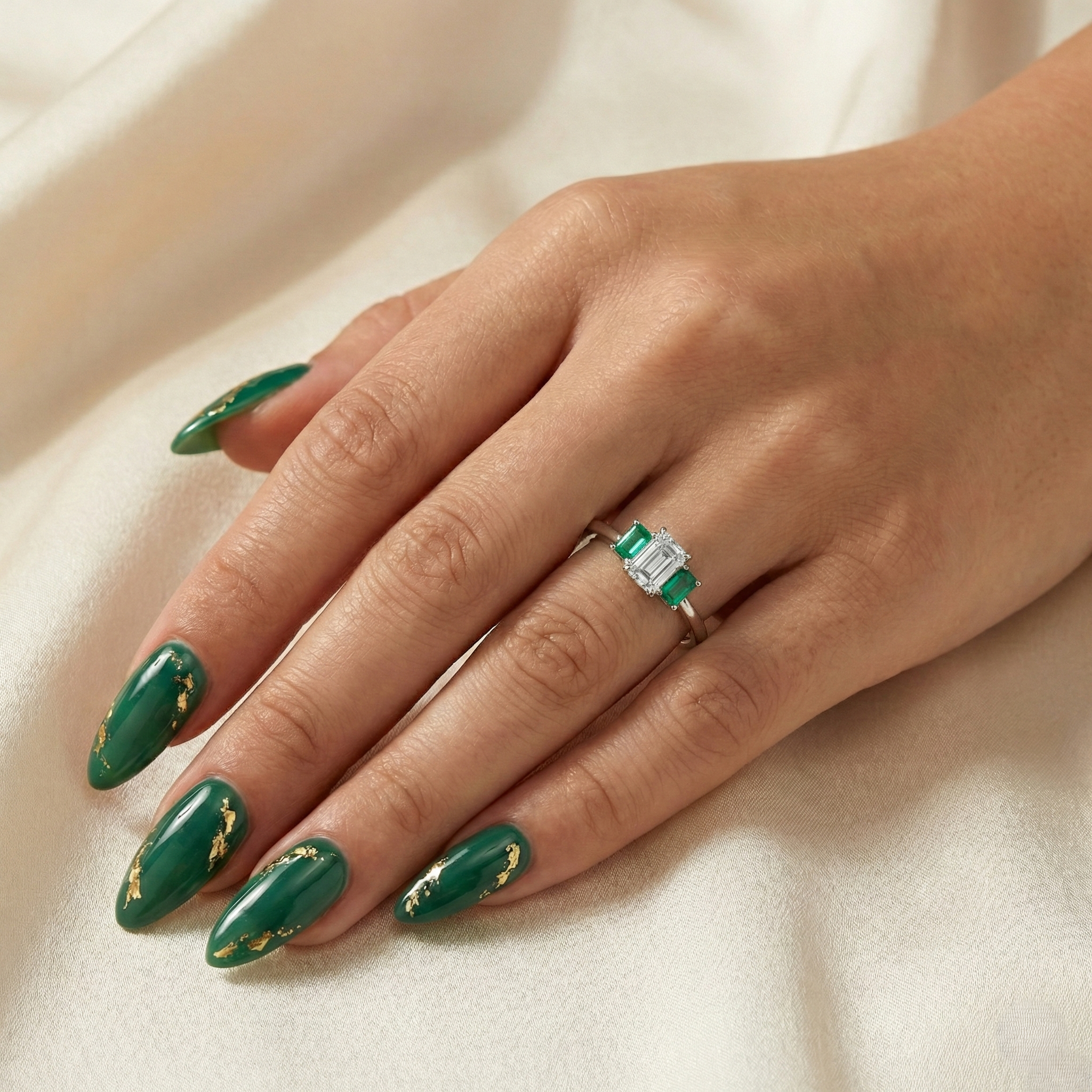
- Trilogy: a coloured centre with diamonds either side, or the reverse, as in our diamond trilogy with emerald side stones.
- Solitaire: clean and simple, best for tough sapphires and rubies.
Metals
- Yellow gold warms up emeralds and rubies and gives sapphires a regal, vintage feel. See our yellow vs white gold guide.
- White gold and platinum make blues and teals look crisp and cool, and let a diamond halo shine.
Most of our gemstone rings can be made in 18ct yellow, white or rose gold, or platinum.
Frequently asked questions
Are coloured gemstone engagement rings cheaper than diamonds?
Often, yes, size for size. A beautiful sapphire or emerald can cost much less than a natural diamond of the same size, though the very finest coloured stones can match diamond prices. Our budget guide shows what each budget buys.
Is an emerald engagement ring a bad idea?
Not at all, as long as you go in with your eyes open. Choose a protective setting, take it off for rough jobs and clean it gently, and an emerald will last a lifetime.
What's the most popular coloured engagement stone?
Blue sapphire, by some distance. It's durable, timeless and has a long royal association in Britain.
Do coloured gemstones hold their value?
Fine, untreated stones from top origins can hold their value well. For most rings, though, it's best to choose a stone because you love it rather than as an investment.
Can I have a coloured gemstone ring made to my own design?
Yes. We can source a particular stone and design a setting around it through our bespoke jewellery service.
Can I see the stones in person?
Please do. Coloured gemstones look very different in real life than on a screen, and seeing them in daylight is the best way to choose.
See the colour for yourself
Photos never quite capture how a sapphire glows or an emerald draws you in. Tell us which stones you'd like to see and we'll have them ready. Greville House, 35 Greville Street, Hatton Garden, Monday to Saturday, 10:30am to 5:30pm.
Book an appointmentShop gemstone ringsFree UK delivery, a price match guarantee and flexible payment plans come as standard.